12 Grounding Techniques for Stress to Calm Your Mind Fast
Your heart is racing, your thoughts are spiraling, and you need relief right now, not in an hour, not after a therapy session, but this very moment. That's exactly where grounding techniques for stress come in. These are practical, body-based exercises that pull your attention away from anxious thoughts and anchor you firmly in the present.
At Grant You Greatness, Dr. Grant Horner works with clients across North County San Diego who face anxiety, overwhelming transitions, and the kind of stress that makes ordinary days feel impossible. One thing he consistently teaches? You don't have to white-knuckle your way through panic. There are concrete tools you can use anywhere, at your desk, in your car, or lying awake at 2 a.m.
This guide walks you through 12 grounding techniques designed to calm your nervous system fast. Some focus on your senses, others on movement or breath. All of them are simple enough to try right now, no equipment, no apps, no prior experience required.
1. Build a grounding plan with a therapist
Working with a therapist to create a personalized grounding plan is different from Googling stress tips at midnight and hoping something sticks. A trained counselor helps you identify your specific anxiety triggers, test out which grounding techniques for stress actually work for your nervous system, and build a plan that fits your life. This isn't about generic advice. It's about creating a roadmap you can follow when panic hits and your thinking brain goes offline.
What it is
A grounding plan is a written or mental set of steps you can follow during moments of acute stress or anxiety. Your therapist works with you to select techniques based on your unique symptoms, lifestyle, and stress patterns. Some people need physical movement to calm down. Others respond better to sensory input or breathing exercises. The plan acts as your personal emergency toolkit, tested and refined with professional guidance so you know it works before you need it most.
How to do it
Start by scheduling a session with a therapist who specializes in anxiety or stress management. During your sessions, you'll discuss what stress feels like in your body, when it typically strikes, and what you've already tried. Your therapist will introduce several grounding methods and help you practice them in real time. Together, you'll narrow down two to four techniques that resonate with you. You'll write them down in order of preference, noting when to use each one and any modifications that make them easier to execute.
"A therapist doesn't just hand you a technique. They help you practice until it becomes automatic, so you can reach for it when your brain is too overwhelmed to think clearly."
When it works best
This approach works best before you're in crisis mode. Building a grounding plan is preventive work. It's most effective when you're dealing with chronic anxiety, recurring panic attacks, or predictable stress triggers like work presentations or family gatherings. If you wait until you're spiraling, you won't have the mental bandwidth to evaluate what might help. The time to build the plan is when you're calm enough to think, test, and refine.
Make it easier in real life
Keep your grounding plan accessible. Type it into your phone's notes app or write it on an index card you carry in your wallet. Practice your chosen techniques at least once a week when you're not stressed so they become second nature. If cost is a barrier, look for therapists who offer sliding scale fees or check whether your insurance covers telehealth sessions, which many North County San Diego providers now offer.
2. Use the 5-4-3-2-1 senses check-in
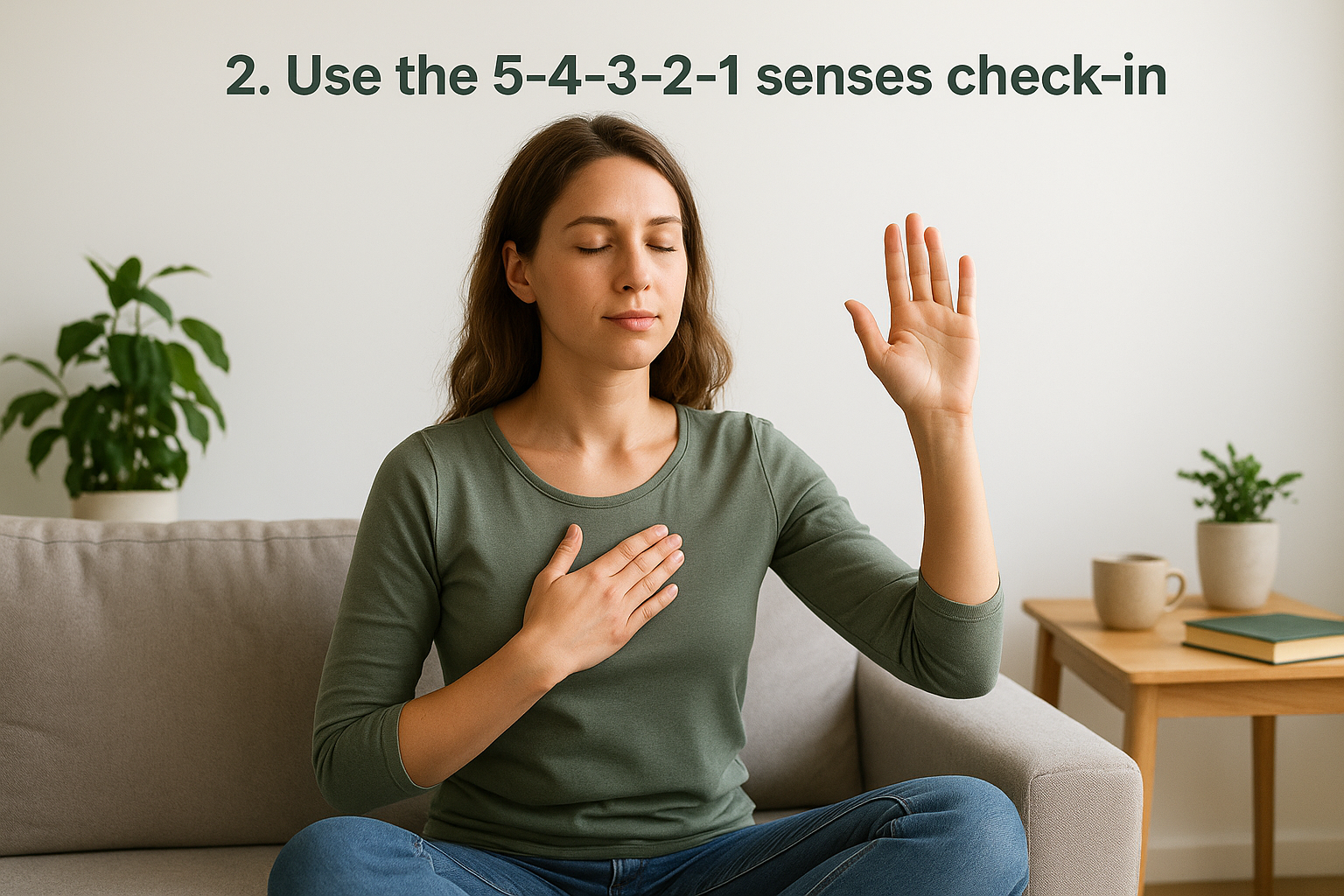
The 5-4-3-2-1 technique is one of the most popular grounding techniques for stress because it forces your brain to engage with your physical surroundings instead of spiraling into anxious thoughts. When you're caught in a stress response, your nervous system is stuck in fight-or-flight mode. This method interrupts that pattern by directing your attention to concrete sensory details that exist only in the present moment.
What it is
This technique asks you to identify specific things you can perceive through each of your five senses. You work through them in descending order: five things you see, four things you can touch, three things you hear, two things you smell, and one thing you taste. The process shifts your focus from internal worry to external reality, pulling you out of your head and back into your body.
How to do it
Start by noticing five things you can see around you. Name them silently or out loud: a blue pen, a crack in the wall, your shoe. Then move to four things you can physically touch: the chair beneath you, your phone's smooth surface, the texture of your jeans. Continue with three things you hear, two things you smell, and one thing you taste. If you can't detect a smell or taste, focus extra attention on the earlier senses or simply move through the exercise twice.
"This isn't about finding profound meaning. It's about naming ordinary details until your nervous system realizes there's no actual danger in this moment."
When it works best
This technique works best when anxiety is building but hasn't peaked yet. It's ideal for situations where you're stuck in one place, like sitting at your desk, waiting in traffic, or lying in bed unable to sleep. You need just enough mental clarity to count and name objects. If you're already in full panic mode, you might need a more physical intervention first, like cold water or movement.
Make it easier in real life
Keep the 5-4-3-2-1 sequence written on your phone's lock screen or memorized through repetition. Practice the technique once daily when you're calm, like during your morning coffee or evening walk. This builds muscle memory so you can execute it automatically when stress strikes. If counting backwards feels confusing, just remember "see five, touch four, hear three, smell two, taste one."
3. Try the 3-3-3 rule for anxiety
The 3-3-3 rule is a streamlined cousin of the 5-4-3-2-1 method, designed for moments when you need something faster and easier to remember. While other grounding techniques for stress require counting through multiple senses, this one focuses on just three elements: what you see, what you hear, and what you can move. It's built for speed without sacrificing effectiveness.
What it is
The 3-3-3 rule breaks down into three simple steps. You name three things you see, then identify three sounds you hear, and finally move three parts of your body. That's it. The repetition of three makes it stick in your memory even when your brain feels foggy. Each step grounds you in a different way: visual awareness, auditory focus, and physical sensation through movement.
How to do it
Start by looking around and naming three objects you can see right now. Say them aloud if possible: "desk lamp, coffee mug, window." Next, pause and listen for three distinct sounds: traffic outside, the hum of your computer, your own breathing. Finally, move three body parts in any way that feels natural. Wiggle your fingers, rotate your ankles, roll your shoulders. The movement doesn't need to be large or dramatic to work.
"The physical movement component is what makes this rule different. It tells your body you're safe enough to move freely, which directly counters the freeze response anxiety triggers."
When it works best
This technique works best during moderate anxiety spikes when you can still think somewhat clearly but feel yourself starting to spiral. It's particularly useful in public settings where you need discretion. You can execute the entire sequence while sitting at a meeting, standing in line, or riding public transit without drawing attention to yourself.
Make it easier in real life
Practice the 3-3-3 rule during calm moments so it becomes automatic. Set a daily reminder on your phone to run through it once, even when you're not stressed. If remembering the sequence feels hard, repeat "see, hear, move" three times as a memory anchor. Keep the pattern simple and resist the urge to overcomplicate it with additional steps.
4. Do box breathing for quick nervous system reset
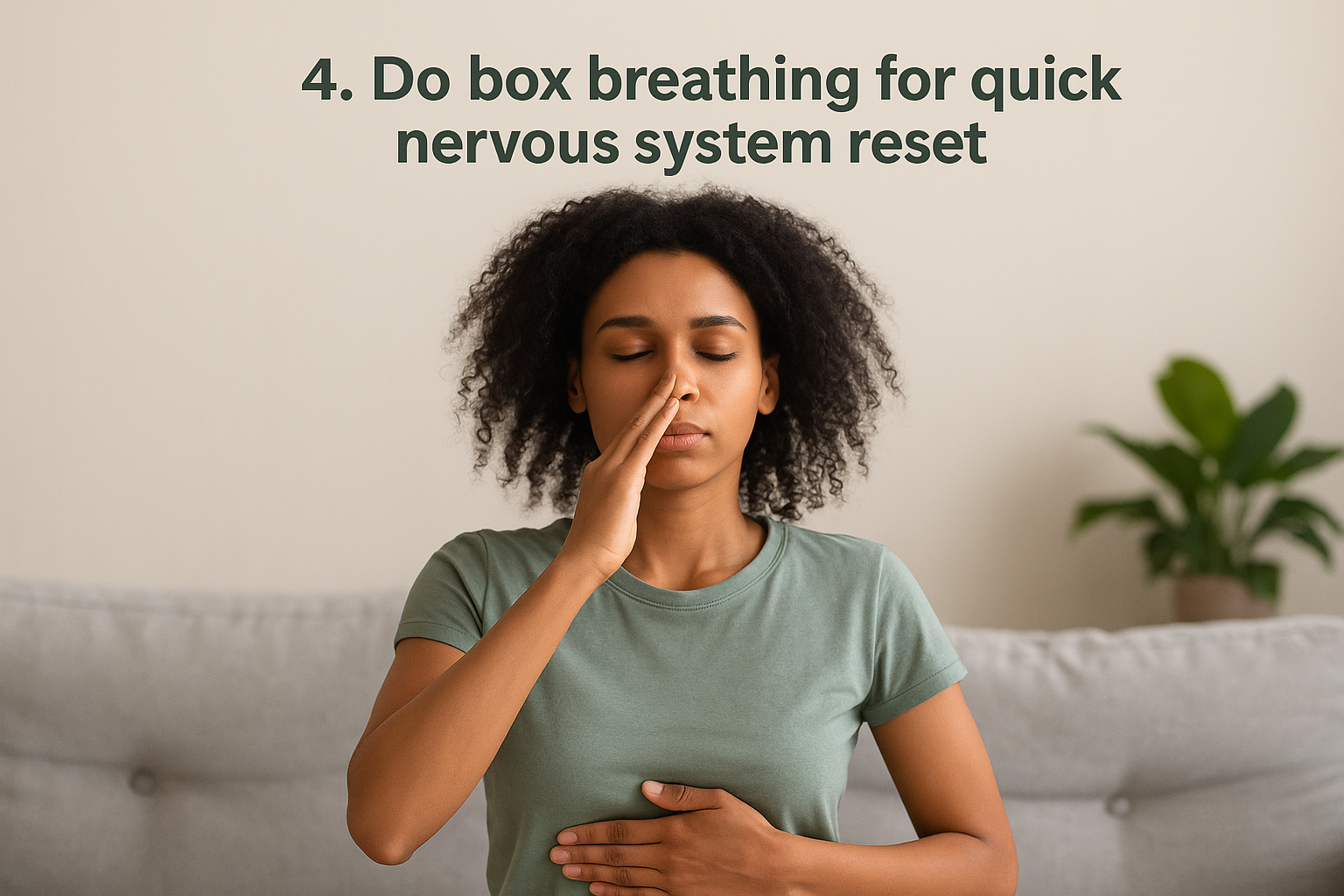
Box breathing is a structured breathing pattern used by Navy SEALs, emergency responders, and therapists to trigger an immediate calm response in high-stress situations. Unlike casual deep breathing, this technique follows a precise four-count rhythm that forces your parasympathetic nervous system to override your body's stress response. Among all grounding techniques for stress, box breathing stands out because you can do it anywhere without anyone noticing.
What it is
Box breathing divides each breath cycle into four equal parts: inhale, hold, exhale, hold. Each phase lasts the same count, typically four seconds, creating a square or "box" pattern. This equal timing activates your vagus nerve, which directly signals your body to shift from fight-or-flight into rest mode. The held breath after exhaling is what makes this different from standard deep breathing exercises.
How to do it
Start by exhaling completely to empty your lungs. Breathe in through your nose for a count of four. Hold that breath for four counts. Exhale slowly through your mouth for four counts. Hold your lungs empty for another four counts. Repeat this cycle four to six times or until you feel your heart rate slow. Keep your shoulders relaxed and your jaw loose throughout the entire process.
"The magic isn't in breathing deeply. It's in the holds between breaths, which force your nervous system to recalibrate and reset."
When it works best
This technique works best when you're anticipating a stressful event or caught in the middle of one. Use it before presentations, difficult conversations, or medical appointments. It's also effective when you wake up anxious or can't fall asleep because your mind won't stop racing.
Make it easier in real life
Practice box breathing twice daily for one week when you're calm so the pattern becomes automatic. If four seconds feels too long, start with three-second intervals and build up gradually. Set a discreet timer on your phone or simply count silently in your head.
5. Use 4-7-8 breathing to slow racing thoughts
The 4-7-8 breathing technique is a longer, deeper pattern than box breathing, specifically designed to slow your heart rate and interrupt the mental loop of racing thoughts. Developed by Dr. Andrew Weil and based on ancient yogic breathing practices, this method extends your exhale longer than your inhale, which activates a natural sedative effect in your nervous system. It's one of the most effective grounding techniques for stress when your mind won't stop spinning.
What it is
This technique follows an uneven breathing ratio: inhale for four counts, hold for seven, and exhale for eight. The extended hold and prolonged exhale force your body to enter parasympathetic mode, the state where rest and recovery happen. Unlike equal-count breathing patterns, the deliberately longer exhale signals your brain that you're safe enough to slow down, making it particularly effective for anxious thought spirals.
How to do it
Place the tip of your tongue against the roof of your mouth, just behind your front teeth. Keep it there throughout the entire exercise. Exhale completely through your mouth, making a whooshing sound. Close your mouth and inhale quietly through your nose while counting to four. Hold your breath for seven counts. Exhale completely through your mouth for eight counts, making the whooshing sound again. Repeat this cycle three to four times total.
"The tongue placement isn't optional. It creates a circuit in your mouth that helps regulate the breath and keeps you focused on the physical mechanics instead of your anxious thoughts."
When it works best
This technique works best when your thoughts are racing but you're physically still. Use it when you're lying awake at night, sitting through a long meeting where your mind keeps wandering to worst-case scenarios, or trying to calm down after a stressful conversation. It's particularly effective before sleep because the extended exhale prepares your body for rest.
Make it easier in real life
Start with just three cycles rather than trying to do it for several minutes. If holding your breath for seven counts feels uncomfortable, reduce all numbers proportionally: try 3-5-6 or even 2-4-6 until you build capacity. Practice this technique daily at bedtime for two weeks so it becomes automatic when stress hits.
6. Clench and release to discharge stress
Progressive muscle relaxation isn't just a gentle stretching technique. It's a deliberate physical intervention that helps your body release the tension it's been holding onto during stress. This method of clenching and releasing muscle groups forces your nervous system to recognize the difference between tension and relaxation, which interrupts the physical grip anxiety has on your body. Unlike other grounding techniques for stress that focus on breathing or sensory awareness, this one uses movement to discharge the stress response directly.
What it is
This technique involves systematically tensing specific muscle groups for several seconds, then releasing them completely. You move through your body from one area to the next, creating a wave of relaxation that follows each release. The contrast between the clenched state and the released state teaches your nervous system what relaxation actually feels like, making it easier to recognize and release tension when it builds up throughout your day.
How to do it
Start with your fists and forearms. Clench them tight for five seconds, then release completely. Move to your biceps and shoulders, tensing them toward your ears, holding, then dropping. Continue down through your face, jaw, neck, chest, stomach, glutes, thighs, calves, and feet. Hold each tension for five full seconds, then release for ten seconds before moving to the next area. The release is more important than the clench.
"The release phase is where the magic happens. That's when your muscles actually let go of the stress they've been carrying, sometimes for hours or days."
When it works best
This technique works best when you're physically tense and can feel knots in your shoulders, jaw, or back. Use it at the end of a stressful day, before bed, or after situations that leave your body tight and uncomfortable. It's particularly effective when you've been sitting still for hours but feel wound up inside.
Make it easier in real life
Work through just three muscle groups if doing your whole body feels overwhelming: your fists, your shoulders, and your jaw. These three areas hold the most stress for most people. Practice this technique once before bed each night to build the habit, even on days when you don't feel particularly stressed.
7. Reset with cold water or an ice cube
Cold exposure triggers an immediate physiological response called the dive reflex, which rapidly slows your heart rate and redirects blood flow to your vital organs. This isn't about toughing it out or building character. It's a biological interrupt button that forces your nervous system to shift priorities from panic mode to survival adaptation. Among all grounding techniques for stress, cold water stands out because it works even when your thinking brain has completely shut down.

What it is
The dive reflex is an ancient survival mechanism that activates when your face comes into contact with cold water. Your body interprets this as a signal that you might be submerging, so it automatically slows your heart rate and constricts blood vessels to preserve oxygen. This response directly counteracts the racing heart and rapid breathing that accompany anxiety attacks, creating an involuntary calm that bypasses your conscious control entirely.
How to do it
Fill a bowl with cold water and ice cubes, then submerge your face for 15 to 30 seconds. If that feels too intense, hold an ice cube against your wrists, neck, or behind your ears for 30 seconds. You can also splash cold water on your face repeatedly, focusing on your forehead and cheeks. The colder the water, the stronger the response, but even cool tap water will activate the reflex to some degree.
"Your body can't maintain a panic response when the dive reflex kicks in. The two states are physiologically incompatible."
When it works best
This technique works best during acute panic attacks when gentler methods aren't cutting through the intensity. Use it when your heart is pounding, you feel disconnected from reality, or breathing exercises aren't slowing your thoughts. It's particularly effective for nighttime anxiety when you're spiraling and need something that works within seconds, not minutes.
Make it easier in real life
Keep a gel ice pack in your freezer or a bowl you can quickly fill with cold water. If you're at work or in public, run cold water over your wrists in the bathroom for 30 seconds. Carry a small reusable ice pack in your bag during particularly stressful periods so you always have access to cold when you need it.
8. Do a quick body scan from head to toe
A body scan is a mental inventory of physical sensations that pulls your attention away from anxious thoughts and anchors it in your actual body. Unlike other grounding techniques for stress that rely on external objects or deliberate breathing patterns, this method uses your own physical presence as the grounding tool. You move your awareness through your body systematically, noticing tension, temperature, and sensation without trying to change anything.
What it is
A body scan is a focused attention exercise where you mentally move through each part of your body from head to toe, noting what you feel without judgment. You're not trying to relax specific areas or fix anything. You're simply observing sensations as they exist in this moment: tightness in your jaw, warmth in your hands, pressure where your feet touch the floor. This practice interrupts anxious thought patterns by redirecting your awareness to concrete physical information your body is sending you right now.
How to do it
Start at the top of your head and slowly move your attention downward. Notice your scalp, forehead, eyes, jaw, and neck. Continue to your shoulders, arms, hands, chest, stomach, hips, thighs, knees, calves, and feet. Spend three to five seconds on each area. You don't need to do anything with what you notice. Just name the sensation silently: "My shoulders feel tight. My hands feel warm." Move steadily downward without skipping areas or rushing.
"The goal isn't to feel good. It's to feel what's actually there, which gives your mind something real to focus on instead of imagined threats."
When it works best
This technique works best when you're lying down or sitting still and have a few uninterrupted minutes. Use it during sleepless nights, meditation sessions, or wind-down time after work. It's particularly effective when anxiety feels vague and unfocused rather than tied to a specific worry.
Make it easier in real life
Complete a two-minute version by checking only five body regions: head, shoulders, hands, stomach, and feet. Practice this shortened scan daily during your lunch break or before sleep. If your mind wanders, simply return to wherever you left off without judgment.
9. Label what you see like a narrator
Narrating your surroundings out loud forces your brain to engage with the present moment instead of spinning through anxious scenarios. This technique turns you into a neutral observer of your environment, describing what you see as if you're commentating on a scene in a movie. Unlike other grounding techniques for stress that require specific breathing patterns or body positions, this one only needs your voice and your eyes.
What it is
Narration grounding is the practice of describing your immediate environment in simple, factual terms as if you're a sports announcer or documentary narrator. You speak in third person or present tense, noting objects, colors, shapes, and movements without adding emotional commentary or judgment. The goal is to activate the logical part of your brain that processes language and observation, which temporarily overrides the emotional part generating your anxiety.
How to do it
Look around and start describing what you see in complete sentences: "There is a white wall. The clock shows 3:15. A car is driving past the window." Continue for one to two minutes, speaking either aloud or in your head. Stick to observable facts rather than interpretations. Say "the cup is blue" instead of "that's a nice cup." Keep your descriptions simple and move from object to object without dwelling on any single item.
"Your brain can't narrate the present and catastrophize about the future at the same time. The two processes compete for the same mental resources."
When it works best
This technique works best when you're alone or in a private space where speaking aloud won't feel awkward. Use it during rumination spirals when your thoughts keep returning to the same worry loop. It's particularly effective in familiar environments like your home or office where anxiety makes everything feel surreal or disconnected.
Make it easier in real life
Practice narration for 30 seconds daily in your car or during your morning routine so it feels natural when stress hits. If speaking aloud feels uncomfortable, narrate silently in your head using the same factual, observational tone. Start each description with "I see" or "There is" to maintain the neutral observer perspective.
10. Play categories and quick math
Mental games force your prefrontal cortex to engage with logic and recall, which temporarily shuts down the amygdala's panic response. When you challenge your brain to name items in a category or solve simple math problems, you're recruiting the cognitive functions that anxiety actively suppresses. This redirection of mental resources is what makes cognitive distraction one of the most portable grounding techniques for stress you can use anywhere without anyone noticing.
What it is
Cognitive grounding uses structured mental tasks to occupy your working memory and pull attention away from anxious thoughts. You pick a category like "types of fruit" or "cities that start with M" and force yourself to generate a list, or you solve basic arithmetic problems like counting backward by sevens from 100. These tasks require just enough mental effort to interrupt anxiety spirals without being so difficult that they add stress.
How to do it
Choose a category or counting task and commit to it for one to two minutes. Name every dog breed you know, list all the blue objects in your house, or recite the months of the year backward. For math, count backward from 100 by threes or sevens. If that feels too hard, multiply single-digit numbers in your head or add up items on a receipt. The specific task matters less than maintaining focus on it.
"The moment your brain starts listing dog breeds, it stops catastrophizing. The two processes can't happen simultaneously because they compete for the same neural pathways."
When it works best
This technique works best during moderate anxiety when your mind is racing but you can still think somewhat clearly. Use it in waiting rooms, during commutes, or before stressful events when you need distraction but can't move around or speak aloud.
Make it easier in real life
Keep a mental list of three categories you know well: favorite movies, places you've lived, or foods you dislike. Practice recalling these lists once daily so they're automatic when stress hits. If remembering categories feels hard, count backward from 50 by twos as your default mental task.
11. Use an anchoring statement to orient yourself
Anchoring statements are verbal declarations that connect you to concrete facts about your current reality when anxiety makes everything feel unstable or surreal. These simple, present-tense phrases remind your brain where you are, who you are, and that you're safe right now. Unlike other grounding techniques for stress that require physical movement or sensory engagement, this method uses language itself as the grounding tool.
What it is
An anchoring statement is a factual sentence you speak aloud or repeat silently that grounds you in the present moment. These statements describe objective truths about your current situation: your name, location, the date, or a simple observation about your safety. The act of stating these facts activates the logical processing centers of your brain, interrupting the emotional spiraling that fuels anxiety and panic.
How to do it
Create a personal anchoring phrase that includes several concrete details: "My name is [your name]. I am sitting in [location]. Today is [day and date]. I am safe right now." Speak this statement aloud if possible, or repeat it silently three to five times. You can modify the statement to fit your situation by adding details like "I am breathing. My feet are on the ground. Nothing is chasing me."
"The power isn't in the words themselves. It's in forcing your brain to process factual information instead of imagined threats."
When it works best
This technique works best during dissociation or derealization, when anxiety makes your surroundings feel unreal or dreamlike. Use it when you feel disconnected from your body or when panic makes you forget basic facts about where you are or what you're doing.
Make it easier in real life
Write your core anchoring statement in your phone's notes app so you can read it when your memory fails you. Practice saying it once daily during calm moments so the words become automatic when stress hits. Keep the statement simple and short, no more than three sentences.
Your next calm step
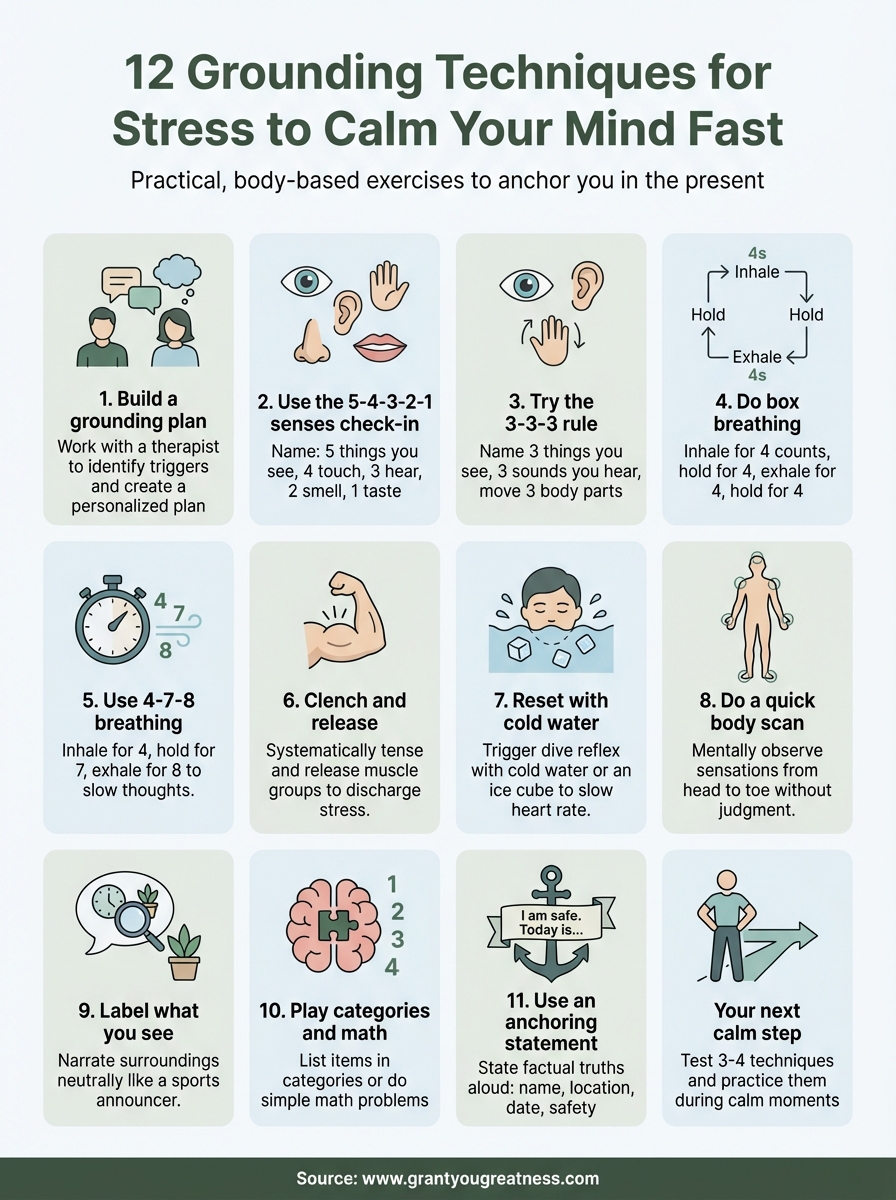
You now have twelve different grounding techniques for stress that you can use the moment anxiety starts building. Some will work better for you than others, and that's exactly why this list exists. Your job isn't to master all of them. It's to test three or four until you find the ones that actually calm your nervous system when you need them most.
Practice your chosen techniques during calm moments so they become automatic when stress hits. Set reminders on your phone, write them down, or simply run through one each morning. The more familiar these tools become, the less you'll have to think about them during an actual anxiety spike.
If you're still struggling to manage stress on your own, working with a therapist at Grant You Greatness can help you build a personalized plan that fits your specific triggers and lifestyle. Dr. Horner offers both in-person and online sessions throughout North County San Diego.