12 Therapy Goals for Depression With Measurable Examples
Depression can feel like being stuck in quicksand, the harder you try to move forward, the more exhausted you become. But here's what often gets overlooked: effective treatment isn't just about "feeling better." It requires clear therapy goals for depression that you can actually measure and track over time.
Without specific objectives, therapy sessions can drift aimlessly. You might spend months talking without a clear direction, leaving you wondering if you're making any real progress. Measurable goals change that dynamic entirely. They give both you and your therapist concrete benchmarks to work toward.
At Grant You Greatness, Dr. Grant Horner uses a practical, goal-oriented approach that moves beyond traditional talk therapy. With over 20 years of clinical experience, he helps clients in North County San Diego and beyond create actionable treatment plans that produce tangible results.
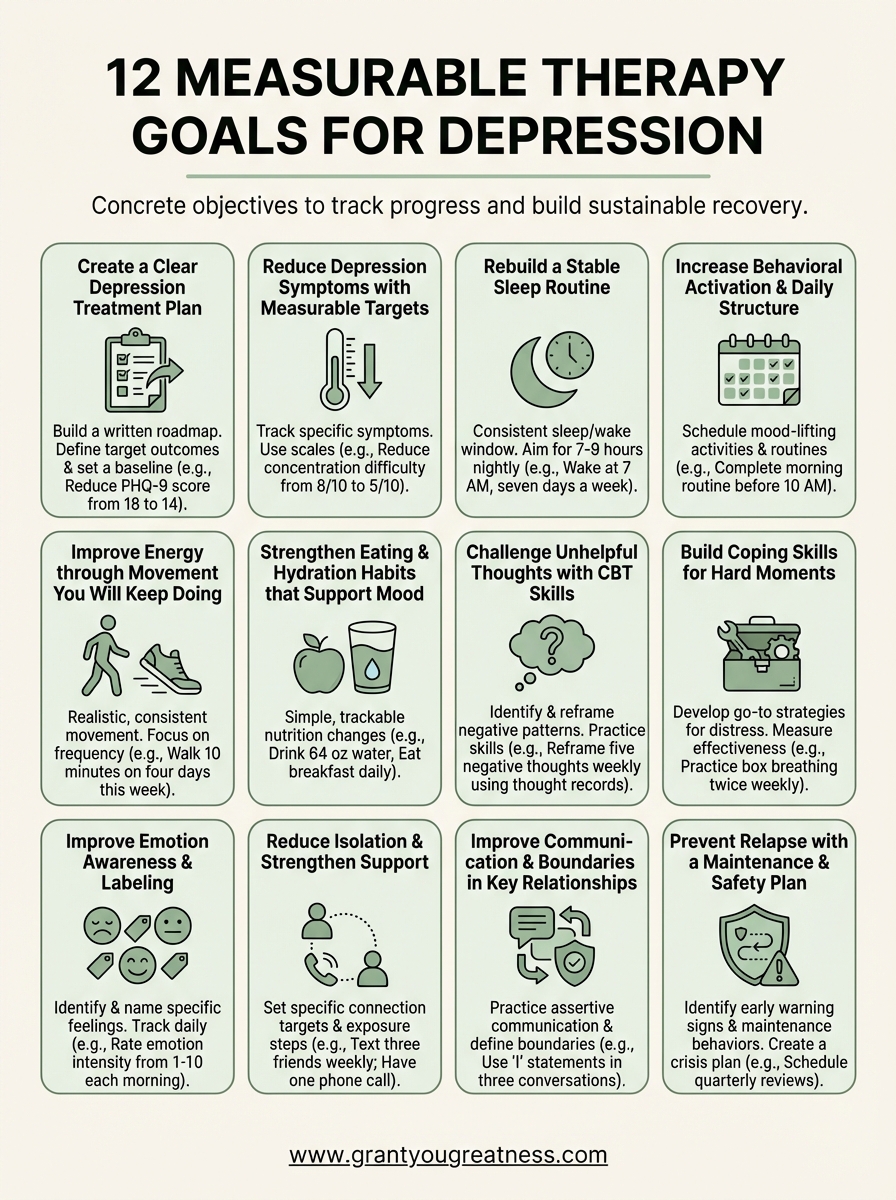
This article outlines 12 therapy goals for depression, complete with measurable examples you can adapt for your own treatment. Whether you're a client looking to take more ownership of your healing or a mental health professional refining your clinical documentation, you'll find specific, practical objectives to guide the work ahead.
1. Create a clear depression treatment plan
The first step in effective depression treatment is building a written plan that outlines exactly where you are now and where you want to go. Without this roadmap, therapy goals for depression become vague wishes rather than actionable objectives. Your treatment plan serves as both a contract with yourself and a communication tool with your therapist, ensuring everyone stays aligned on what progress actually looks like.

A strong treatment plan doesn't need to be complicated. You need clear problem statements, specific goals, and measurable indicators that tell you whether you're moving in the right direction. This structure transforms abstract hope into concrete action steps you can track week by week.
Define what "better" looks like for you
Start by describing your target outcome in specific, observable terms. Instead of "I want to feel better," you might say "I want to wake up without dreading the day ahead" or "I want to enjoy activities I used to love." These concrete descriptions give you something real to work toward rather than chasing an undefined feeling.
Your definition of "better" should reflect your values and priorities, not what you think you're supposed to want. Write down three to five areas where depression has stolen the most from your life. Then describe what reclaiming those areas would look like in behavioral terms that anyone could observe and verify.
Set a baseline with simple measures
You need a starting point to measure progress against. Pick two or three simple tracking tools such as a depression symptom scale (like the PHQ-9), a daily mood rating from 1 to 10, or a count of days you complete your morning routine. Baseline measurements don't have to be perfect, they just need to capture where you are right now.
Without knowing your baseline, you can't measure improvement or recognize when strategies aren't working.
Track your baseline for one to two weeks before expecting change. This patience pays off because it gives you reliable data and prevents you from mistaking normal day-to-day fluctuations for real progress or setbacks.
Write measurable short-term objectives
Break your larger goals into 30-day objectives you can actually verify. For example, "Reduce PHQ-9 score from 18 to 14," "Get out of bed by 8 a.m. on five out of seven days," or "Attend three social activities this month." Each objective should include a number, frequency, or deadline that removes any ambiguity about whether you achieved it.
Your objectives should challenge you without overwhelming you. If an objective feels impossible, break it down further into smaller steps you can build on. Success breeds motivation, so start with wins you can achieve consistently.
Review and adjust the plan on a schedule
Set a review date every two to four weeks to evaluate what's working and what needs to change. During each review, compare your current measurements to your baseline and ask yourself which strategies moved the needle. Drop interventions that aren't helping and double down on what is.
Depression treatment rarely follows a straight line. Your plan needs built-in flexibility to account for setbacks, plateaus, and unexpected life events. Regular reviews keep you responsive rather than rigidly attached to approaches that have stopped producing results.
2. Reduce depression symptoms with measurable targets
One of the most effective therapy goals for depression is to track specific symptoms you want to reduce rather than waiting to magically "feel better." When you measure concrete symptoms like sleep disruption, low motivation, or persistent sadness, you create accountability and can spot patterns that inform your treatment. Tracking transforms vague suffering into data you can act on.
Pick symptom targets that matter most day to day
Focus on the two or three symptoms that disrupt your daily functioning the most. You might choose difficulty concentrating at work, lack of appetite, or the inability to enjoy time with loved ones. These high-impact targets give you clear feedback about whether your treatment is working where it matters most to you.
Use a symptom scale to quantify progress
Choose a validated depression scale like the PHQ-9 or a simple 1-to-10 daily rating for each symptom you're tracking. Assign numbers to subjective experiences so you can compare week-to-week changes objectively. A scale removes the guesswork and shows you whether strategies are producing measurable relief.
Quantifying symptoms turns abstract suffering into concrete progress you can see.
Set time-bound improvement milestones
Establish realistic improvement targets with deadlines, such as "Reduce concentration difficulty from 8/10 to 5/10 within six weeks." Time-bound goals create urgency and help you and your therapist know when to adjust your approach if progress stalls. Your milestones should challenge you without setting you up for discouragement.
Plan what to do if symptoms spike
Create a written response plan for when symptoms suddenly worsen. List three specific actions you'll take, such as calling your therapist, using a grounding technique, or reaching out to your support person. Having this plan ready prevents you from making decisions in crisis mode when your judgment is compromised by distress.
3. Rebuild a stable sleep routine
Poor sleep both causes and worsens depression, creating a cycle that drains your energy and amplifies negative thoughts. One of the most practical therapy goals for depression is stabilizing your sleep schedule through specific, trackable behaviors. When you set measurable sleep targets, you transform an overwhelming problem into concrete steps you can monitor and adjust based on real results.
Choose a consistent sleep and wake window
Pick a seven-day wake time and stick to it even on weekends, then work backward to set a bedtime that allows seven to nine hours of sleep opportunity. Your wake time matters more than your bedtime because it anchors your circadian rhythm. Write down your target window and track how many days per week you hit both times within a 30-minute margin.
Set measurable sleep hygiene behaviors
Identify three specific behaviors you'll practice nightly, such as no screens 60 minutes before bed, keeping your bedroom at 68 degrees, or using a wind-down routine at the same time each evening. Tracking whether you complete these behaviors gives you accountability data separate from whether you actually fall asleep, which you can't always control directly.
Building sleep hygiene habits gives you control over the inputs even when sleep itself feels unpredictable.
Track sleep quality and daytime energy
Rate your sleep quality from 1 to 10 each morning and your afternoon energy level at 3 p.m. daily. These two measurements show you whether your sleep changes are producing functional improvements in your waking life. Look for patterns over two-week periods rather than obsessing over single nights.
Troubleshoot common sleep setbacks
Create a written protocol for nights when you can't fall asleep within 30 minutes, such as getting up and doing a calming activity rather than lying awake. Plan how you'll handle unavoidable schedule disruptions like travel or emergencies so you can return to your routine quickly rather than letting one bad night derail your progress.
4. Increase behavioral activation and daily structure
Depression convinces you to do less, which makes you feel worse, which makes you do even less. Breaking this cycle requires behavioral activation, one of the most evidence-backed therapy goals for depression. You don't wait to feel motivated before taking action. Instead, you build structure and activity into your day, then let the motivation follow. Setting measurable targets for what you do daily gives you control over one of the few things depression can't steal: your choices.

Identify "minimum viable" daily routines
Start by choosing three non-negotiable daily behaviors that anchor your day, such as making your bed, eating breakfast, or taking a shower before 10 a.m. These routines should be simple enough that you can complete them even on your lowest-energy days. Write them down and track completion with checkmarks to build consistency before adding more demanding tasks.
Schedule mood-lifting activities on purpose
Pick two activities per week that historically improved your mood, such as calling a friend, walking outside, or working on a hobby. Put these activities in your calendar with specific times rather than leaving them to chance. Depression will tell you to skip them, so treating them like appointments removes the decision-making burden when motivation is low.
Set weekly activity goals you can count
Choose a measurable weekly target like "Complete five planned activities" or "Spend three hours outside the house." Counting completions gives you objective data about whether you're expanding your behavioral repertoire. Celebrate hitting your weekly number even when the activities themselves felt difficult or unrewarding.
Track follow-through and mood shifts
Record whether you completed each planned activity and rate your mood immediately after on a 1-to-10 scale. This tracking reveals patterns between action and mood that depression tries to hide from you. Most clients discover that their mood improves after activity completion, even when they had zero desire to start.
Tracking shows you that action precedes motivation, not the other way around.
5. Improve energy through movement you will keep doing
Exercise is one of the most powerful therapy goals for depression, but the traditional "hit the gym" advice sets most people up to fail. Depression drains your motivation and energy, making intense workouts feel impossible. Instead, you need movement goals that match your current capacity and build from there. The key is choosing activities you'll actually sustain rather than forcing yourself into routines you'll abandon within a week.
Pick a realistic movement target
Choose an activity that requires minimal preparation and decision-making, such as a 10-minute walk around your block or five minutes of stretching in your living room. Your starting point should feel almost too easy because consistency beats intensity when you're fighting depression. Write down one specific movement you'll commit to this week without worrying about whether it "counts" as real exercise.
Set frequency, duration, and intensity goals
Define your weekly movement target with numbers you can track: "Walk 10 minutes on four days" or "Do body-weight exercises for 15 minutes three times per week." Start with frequency goals before adding duration or intensity. Track completions with simple checkmarks rather than obsessing over performance metrics that can become discouraging.
Movement goals work best when you remove the pressure to perform and focus only on showing up.
Use simple tracking and accountability
Log each completed session in a visible location like a calendar on your fridge or a note on your phone. Share your weekly goal with one person who will check in without judgment. Accountability through tracking and support increases follow-through when your internal motivation disappears.
Adjust the plan for low-motivation days
Create a backup movement option that takes half the time or effort of your regular goal, such as a five-minute walk when 10 minutes feels impossible. Having this preset alternative prevents all-or-nothing thinking that leads to skipping movement entirely on difficult days.
6. Strengthen eating and hydration habits that support mood
Depression often disrupts your appetite and eating patterns, creating a physical foundation that worsens mental symptoms. Poor nutrition depletes your energy, clouds your thinking, and intensifies mood swings. Making eating and hydration measurable therapy goals for depression gives you control over basic inputs that directly affect how you feel throughout the day.
Choose one nutrition change you can measure
Start with one specific change you can track daily, such as eating breakfast within an hour of waking, drinking 64 ounces of water, or having protein at lunch. Avoid vague goals like "eat healthier" that create confusion about what counts as success. Your chosen change should feel manageable even on difficult days so you build momentum rather than setting yourself up for failure.
Set weekly meal and snack objectives
Define your weekly targets with numbers, such as "Eat three balanced meals on five days" or "Have two planned snacks daily four times this week." Breaking nutrition goals into weekly objectives removes the pressure to be perfect every single day. Count completions at the end of each week to see whether your approach needs adjustment.
Reduce appetite-related avoidance patterns
Notice when you skip meals or forget to eat because depression suppresses your hunger signals or makes food preparation feel overwhelming. Set reminder alarms for meal times and keep easy options available that require minimal effort. Your goal is reducing the frequency of avoidance, not achieving perfect nutrition immediately.
Small, consistent nutrition changes often produce noticeable mood improvements within two weeks.
Track patterns without perfectionism
Record your eating and hydration in a simple log without judging yourself for imperfect days. Look for connections between nutrition and energy or mood over two-week periods. This data helps you identify which changes actually move the needle rather than following generic advice that doesn't fit your situation.
7. Challenge unhelpful thoughts with CBT skills
Depression floods your mind with distorted thoughts that feel completely true in the moment. These automatic negative thoughts drive behaviors that keep you stuck. Learning to identify and challenge these patterns through cognitive behavioral therapy (CBT) techniques is one of the most effective therapy goals for depression because it directly interrupts the mental loops that fuel your symptoms.

Name the thought patterns that worsen depression
Start by learning the common thinking errors that depression uses most often, such as all-or-nothing thinking, catastrophizing, or mental filtering. Spend one week simply noticing when these patterns show up without trying to change them yet. Write down three specific examples from your own life where you caught yourself using a distorted thought pattern so you build awareness before attempting modification.
Practice reframing with measurable reps
Set a weekly goal to reframe five negative thoughts using CBT worksheets or thought records. For each distorted thought, write the evidence for and against it, then create a more balanced alternative. Counting your reframing repetitions turns an abstract skill into measurable practice that builds competency over time.
Regular practice with thought records trains your brain to question distortions automatically rather than accepting them as truth.
Test beliefs with small behavioral experiments
Pick one depressive belief you can test through action, such as "Nobody wants to hear from me" or "I'll fail at anything I try." Design a small experiment like texting three friends or attempting one manageable task. Record what actually happened versus what you predicted to gather evidence against your depression's lies.
Track changes in self-talk over time
Rate the believability of common negative thoughts on a 1-to-10 scale weekly. Most clients find that thoughts they once believed at a 9 or 10 drop to 5 or 6 after consistent CBT practice. This tracking shows progress even when depression tries to convince you nothing has changed.
8. Build coping skills for hard moments
Depression hits hardest during unexpected triggers and moments of acute distress. Without prepared coping strategies, these moments send you spiraling into old patterns of avoidance or rumination. Building a reliable toolkit of coping skills becomes one of the most practical therapy goals for depression because it gives you something to do when suffering spikes, rather than just enduring it passively.
Create a short list of go-to coping tools
Choose three to five coping strategies you can use in under 10 minutes, such as box breathing, calling a support person, or using cold water on your face. Your list should include techniques that work for different types of distress, whether you need to calm anxiety, reduce sadness, or interrupt anger. Write this list somewhere you can access quickly when your thinking becomes clouded by emotion.
Set practice goals outside of crises
Commit to practicing each coping skill twice per week when you're not in distress. This repetition builds muscle memory so the techniques feel automatic when you actually need them. Track your practice sessions with simple checkmarks to ensure you're building competency before the next crisis hits.
Measure distress reduction after using skills
Rate your distress level from 1 to 10 before using a coping skill, then rate it again five minutes after. This measurement shows you which strategies actually reduce your suffering and which ones waste time. Your goal is identifying the tools that consistently drop your distress by at least two points.
Measuring distress before and after teaches you which skills earn their place in your toolkit.
Build a plan for triggers you can predict
List three predictable triggers such as conflict with your partner, work deadlines, or family gatherings. For each trigger, write the specific coping skill you'll use and when you'll deploy it. This if-then planning removes decision-making from moments when your judgment is compromised.
9. Improve emotion awareness and labeling
Depression often numbs your ability to recognize and name what you're actually feeling. You might only notice a vague heaviness or know something feels "bad" without being able to identify whether you're sad, anxious, angry, or ashamed. Building emotional awareness as one of your therapy goals for depression gives you crucial information about what you need in any given moment and helps you communicate more effectively with yourself and others.
Track emotions with simple daily check-ins
Set a daily alarm for the same time each day to pause and identify what emotion you're experiencing. Use a simple list of eight to ten basic emotions rather than searching for the perfect descriptor. Record your emotion and its intensity from 1 to 10 in a notes app or journal. This brief practice builds awareness without requiring lengthy reflection that can feel overwhelming when you're depressed.
Increase your ability to name feelings in session
Challenge yourself to use specific emotion words during therapy sessions instead of defaulting to "fine" or "bad." Set a goal to identify and name three distinct emotions per session. Your therapist can help you build your emotional vocabulary and distinguish between feelings that depression often blurs together.
Learning to name emotions accurately gives you the power to address them specifically rather than drowning in undefined suffering.
Connect emotions to needs and values
Practice linking each identified emotion to the underlying need or value it signals. Sadness might point to a need for connection, while anger might reveal a violated boundary. Ask yourself "What is this feeling trying to tell me?" after each daily check-in. This connection transforms emotions from problems into useful information about what matters to you.
Measure progress with frequency and clarity
Track how many emotion words you can identify easily at the start of treatment versus four weeks later. Most clients expand their working vocabulary from three or four vague terms to ten or more specific ones. Your ability to name feelings quickly and accurately demonstrates real progress in self-awareness.
10. Reduce isolation and strengthen support
Depression thrives in isolation, convincing you that withdrawing protects you when it actually deepens your suffering. Social connection acts as a protective factor against depression, yet reaching out feels impossibly difficult when you're struggling. Making social engagement a measurable goal among your therapy goals for depression transforms vague intentions into concrete actions you can track and adjust based on what actually reduces your isolation.
Choose specific connection goals you can count
Pick one or two connection targets you can measure weekly, such as "Text three friends" or "Have one phone conversation lasting at least 10 minutes." Your goals should be small enough that depression can't easily talk you out of them but meaningful enough to create real contact with others. Write down your weekly number and track completions without judging the content or quality of interactions initially.
Set step-by-step exposure for social avoidance
Break larger social situations into graduated steps you can attempt in order, such as responding to a text message, making a brief phone call, meeting for coffee, then attending a group activity. Complete each step at least twice before moving to the next level. This approach prevents the overwhelm that comes from forcing yourself into situations your nervous system isn't ready to handle.
Improve follow-up and consistency with others
Set a specific goal for initiating contact rather than only responding, such as "Reach out first to two people this week." Track how often you follow up after initial conversations to build reciprocal relationships instead of letting connections fade. Consistency matters more than the depth of any single interaction.
Regular, brief contact often strengthens relationships more than sporadic intense interactions.
Track quality of connection, not just quantity
Rate each interaction on a 1-to-10 scale for how connected you felt afterward. This measurement helps you identify which people and activities actually reduce loneliness versus those that leave you feeling drained. Your goal is increasing the frequency of quality connections rather than simply accumulating more social obligations.
11. Improve communication and boundaries in key relationships
Depression doesn't just affect your internal experience; it distorts how you interact with the people closest to you. Poor communication patterns and weak boundaries create relationship stress that worsens your symptoms while healthy relationships buffer against depression. Making relationship skills one of your therapy goals for depression addresses a major environmental factor that either supports or undermines your recovery.
Identify the relationship patterns that fuel depression
Notice which specific interactions consistently leave you feeling worse, such as conflict avoidance that builds resentment, people-pleasing that ignores your needs, or criticism that triggers shame spirals. Write down two or three relationship patterns you recognize in your closest relationships. This awareness gives you concrete targets to change rather than accepting dysfunction as inevitable.
Practice assertive communication with measurable steps
Set a weekly goal to use "I" statements in three conversations where you typically withdraw or become aggressive, such as "I feel frustrated when plans change without notice" instead of attacking or staying silent. Track each attempt at assertive expression regardless of how the other person responds. Your goal is building the skill, not controlling outcomes.
Assertive communication focuses on expressing your truth clearly, not on getting others to agree with you.
Set boundary goals with clear "if-then" rules
Define one boundary you need to establish and write an if-then response, such as "If my sister criticizes my parenting, then I will end the phone call within two minutes." Having predetermined responses removes the decision burden from emotionally charged moments when your judgment becomes unreliable.
Track conflict recovery time and repair attempts
Measure how many hours or days you need to return to baseline after relationship conflicts and whether that time decreases as you practice new skills. Count repair attempts you make, such as checking in after disagreements or apologizing when appropriate, to build patterns of resolution rather than avoidance.
12. Prevent relapse with a maintenance and safety plan
Recovery from depression requires planning for the future, not just managing today. The final and perhaps most important of your therapy goals for depression is building a relapse prevention plan that keeps you stable after symptoms improve. Without this plan, you risk falling back into old patterns when life stress hits or motivation fades.
Identify early warning signs and your response plan
Notice the specific changes that signal depression returning before it becomes severe, such as sleeping past your alarm three days in a row, skipping exercise twice weekly, or isolating from friends. Write down your personal warning signs with the exact actions you'll take when you spot them, such as scheduling an emergency therapy session or restarting your morning routine immediately.
Set maintenance goals for therapy skills and routines
Decide which daily and weekly practices you'll continue after active treatment ends, such as tracking mood twice weekly, using CBT skills during stressful moments, or maintaining your sleep schedule. Set a specific frequency target for each maintenance behavior so you know whether you're staying consistent or slipping.
Maintenance work prevents relapse more effectively than waiting to restart treatment after symptoms return.
Create a crisis plan and support list
Write down the phone numbers of your therapist, psychiatrist, crisis hotline, and two trusted support people you can call during acute distress. Include specific symptoms that trigger using this plan, such as suicidal thoughts lasting more than an hour or inability to get out of bed for three consecutive days.
Decide how you will review progress long term
Schedule quarterly reviews where you retake your baseline measures and assess whether your maintenance plan needs adjustment. This regular check-in catches gradual decline before it becomes a full relapse.
Where to go from here
Setting clear, measurable therapy goals for depression transforms treatment from abstract hope into concrete progress you can track. The twelve goals outlined in this article give you specific targets across sleep, activity, nutrition, thinking patterns, relationships, and relapse prevention. None of these objectives require perfection, they demand consistency and honest tracking.
Your next step is choosing two or three goals that address your most disruptive symptoms right now. Start measuring your baseline this week, then build from there with the structured approach each section provides. Progress happens through small, repeated actions that compound over time.
Dr. Grant Horner specializes in practical, goal-oriented therapy that produces measurable results for clients facing depression. His approach moves beyond traditional talk therapy to create actionable treatment plans that break the patterns keeping you stuck. If you're ready to work with a therapist who prioritizes real progress over endless exploration, schedule a free consultation with Grant You Greatness to discuss your specific situation and build a plan that fits your life.