Mindfulness for Stress Management: Simple Practices to Try
Stress has a way of accumulating quietly, until it doesn't. One morning you wake up with a tight chest, racing thoughts, and the vague sense that you're running on empty. If this sounds familiar, you're not alone. Mindfulness for stress management has become one of the most researched and effective approaches for breaking this cycle, offering a way to interrupt the body's stress response and regain a sense of control.
At Grant You Greatness, Dr. Grant Horner works with clients throughout North County San Diego, and online, who are navigating anxiety, burnout, and the weight of life's transitions. A common thread? Many arrive feeling stuck in reactive mode, constantly putting out fires without ever addressing the root cause. Mindfulness isn't about escaping your problems or achieving some zen-like state. It's about building the skill to respond to stress rather than simply react to it, exactly the kind of practical, action-oriented work we emphasize in counseling.
This guide walks you through simple mindfulness practices you can start using today. You'll learn what the research actually says, how these techniques work in your brain and body, and specific exercises tailored to different situations, whether you're at your desk, lying awake at 2 a.m., or sitting in traffic. No prior experience required.
What mindfulness is and how it eases stress
Mindfulness is the practice of paying attention to the present moment without judgment. It's not about clearing your mind or achieving a particular state of calm. Instead, you train yourself to notice what's happening right now, whether that's your breathing, physical sensations, thoughts, or emotions, and you observe those experiences without immediately reacting or trying to change them. This simple shift in how you relate to your internal experience creates space between a stressor and your response to it, which is where the stress relief actually happens.
The benefits aren't just anecdotal. Research consistently shows that mindfulness for stress management reduces cortisol levels, lowers blood pressure, and improves emotional regulation. Your nervous system operates in two primary modes: the sympathetic "fight or flight" response and the parasympathetic "rest and digest" mode. When you're stressed, your sympathetic system dominates, flooding your body with stress hormones and keeping you in a state of high alert. Mindfulness activates the parasympathetic nervous system, signaling to your brain that it's safe to stand down from that heightened state.
The neuroscience of staying present
Your brain's default mode is to wander, often to past regrets or future worries. Studies using fMRI scans show that mindfulness practice strengthens the prefrontal cortex, the region responsible for executive function and emotional regulation, while reducing activity in the amygdala, your brain's alarm system. This physical change means you literally become better at managing stress over time, not just during meditation sessions but throughout your day.
Think of it this way: your amygdala is like a smoke detector that goes off when it senses danger. In chronic stress, that detector becomes oversensitive, triggering false alarms constantly. Regular mindfulness practice recalibrates that sensitivity, helping your brain distinguish between actual threats and uncomfortable but manageable situations. The result is fewer stress responses to everyday frustrations and a faster recovery when real stressors do appear.
Three ways mindfulness shifts your relationship with stress
Recognition comes before reaction. When you practice mindfulness, you develop the ability to notice stress building before it overwhelms you. You catch the tight shoulders, the shallow breathing, the mental spiral starting, giving yourself the chance to intervene early rather than waiting until you're completely dysregulated.
Acceptance replaces resistance. Stress often compounds because you're not just dealing with the stressor itself but also your frustration about being stressed. You tell yourself you shouldn't feel this way, which creates a second layer of suffering. Mindfulness teaches you to acknowledge what's present without adding that layer of judgment, which paradoxically makes the stress easier to tolerate.
Choice replaces autopilot. Without awareness, your stress responses run automatically. Someone cuts you off in traffic, and before you know it, you're fuming for the next twenty minutes. Mindfulness creates a gap between stimulus and response where you can choose how to proceed. You still feel the initial flash of anger, but you're not compelled to follow it down the usual path.
"Between stimulus and response there is a space. In that space is our power to choose our response. In our response lies our growth and our freedom." – Viktor Frankl
The practical impact shows up in measurable ways. You sleep better because your mind isn't racing at night. You recover from conflicts faster because you're not replaying them endlessly. You make clearer decisions under pressure because your thinking isn't clouded by emotional reactivity. These aren't abstract benefits; they're changes you notice in your day-to-day life within weeks of consistent practice.
How to start safely and set expectations
Starting a mindfulness practice doesn't require special equipment, a perfect environment, or hours of free time. You need five minutes and a willingness to experiment. However, approaching mindfulness for stress management with clear expectations helps you stick with it when results feel slow or when your mind resists the practice. Many people quit early because they expected instant calm or assumed they were "doing it wrong" when their thoughts kept racing. Understanding what's normal and what success actually looks like sets you up for sustainable progress rather than frustration.
Start with realistic timelines
Your first week of mindfulness practice will likely feel awkward, uncomfortable, or even frustrating. You'll notice how busy your mind actually is, which can initially feel like you're getting worse at managing stress rather than better. This awareness is progress, not failure. You're simply seeing clearly what was always there, and that clarity is the foundation for change.
Most people notice subtle shifts in their stress response within two to three weeks of consistent practice. You might catch yourself pausing before reacting to an email that would normally trigger you, or you might notice tension in your shoulders earlier in the day than usual. These small wins matter more than dramatic breakthroughs because they compound over time into significant changes in how you experience stress.
"You can't stop the waves, but you can learn to surf." – Jon Kabat-Zinn
Research on neuroplasticity shows that measurable changes in brain structure appear after about eight weeks of regular mindfulness practice. This doesn't mean you wait two months to feel benefits, but it does mean you're making physical changes to your brain's stress response system that become more pronounced over time. Expect gradual improvement, not instant transformation.
When to check with a professional first
Mindfulness practices are generally safe for most people, but certain conditions warrant professional guidance before you begin. If you're currently experiencing severe depression, active trauma symptoms, or dissociative episodes, talk with a mental health professional first. These conditions can intensify during mindfulness practice because you're turning attention inward without the coping mechanisms you've built to manage difficult emotions.
People with a history of trauma sometimes find that body-focused practices trigger flashbacks or panic. This doesn't mean mindfulness isn't for you; it means you benefit from working with a trauma-informed therapist who can help you modify practices to stay within your window of tolerance. Similarly, if you're managing psychosis or severe anxiety disorders, a mental health professional can help you adapt mindfulness techniques to support your specific needs rather than potentially destabilize your current treatment.
Step 1. Notice your stress signals and triggers
Awareness precedes change. You can't manage stress you don't recognize until it's already overwhelming you. The first practical step in mindfulness for stress management involves developing the skill to spot your body's early warning signs and identifying the specific situations that consistently trigger your stress response. Most people operate on autopilot, only noticing stress when it reaches crisis levels: the panic attack, the explosive argument, the complete shutdown. Building awareness means catching those signals earlier, when you still have options for how to respond.
Physical stress signals to watch for
Your body telegraphs stress long before your mind consciously registers it. Pay attention to changes in your breathing first, since shallow, rapid breathing often appears within seconds of encountering a stressor. You might also notice your jaw clenching, shoulders rising toward your ears, or a knot forming in your stomach. These physical markers are your nervous system's way of preparing for threat, even when the "threat" is just a difficult conversation or a full inbox.
Track where tension lives in your body by doing a quick scan three times throughout your day. Set reminders on your phone for mid-morning, after lunch, and before you leave work. Each time, pause for thirty seconds and mentally move through your body from head to toe. You're not trying to fix anything yet; you're simply gathering data about your baseline patterns. Does your neck tighten during video calls? Do your fists clench when you check email? Write down what you notice for three days to identify patterns.
"The body keeps the score." – Bessel van der Leeuwen
Common stress triggers to track
Specific situations reliably activate your stress response, but you might not see the patterns until you document them. Create a simple tracking log using this structure:
Time: When did you notice stress building?
Situation: What were you doing or what just happened?
Physical signals: What did you feel in your body?
Thoughts: What story was running through your mind?
Intensity: Rate your stress from 1-10
Keep this log for one week, recording entries whenever you notice stress rising. You're looking for recurring themes: certain people, specific tasks, particular times of day, or types of interactions. A client of mine discovered that her stress spiked consistently at 4 p.m., not because of what was happening then, but because she was hungry and hadn't eaten since lunch. Simple pattern, significant impact once she could see it clearly.
Your triggers might include performance evaluations, financial discussions, social events, or even checking certain news sources. Naming these patterns gives you predictive power. When you know Monday morning meetings consistently stress you out, you can prepare mindfulness practices in advance rather than being blindsided by the reaction.
Step 2. Use a breathing reset to calm your body
Your breath is the most direct tool you have for interrupting your stress response. When stress hits, your breathing becomes shallow and rapid, which signals danger to your brain and keeps your sympathetic nervous system activated. Intentionally changing your breathing pattern sends the opposite signal, activating your parasympathetic nervous system and telling your body it's safe to relax. This isn't about achieving perfect calm; it's about creating physiological change that makes stress more manageable. You can use breathing resets anywhere, whether you're sitting in traffic, preparing for a difficult conversation, or lying awake at night.
The 4-7-8 technique for immediate relief
This breathing pattern works because the extended exhale activates your vagus nerve, which triggers your body's relaxation response. You create a longer out-breath than in-breath, which physically slows your heart rate and lowers blood pressure within minutes. Use this technique when you need quick stress relief before a meeting, after receiving upsetting news, or anytime anxiety spikes suddenly.
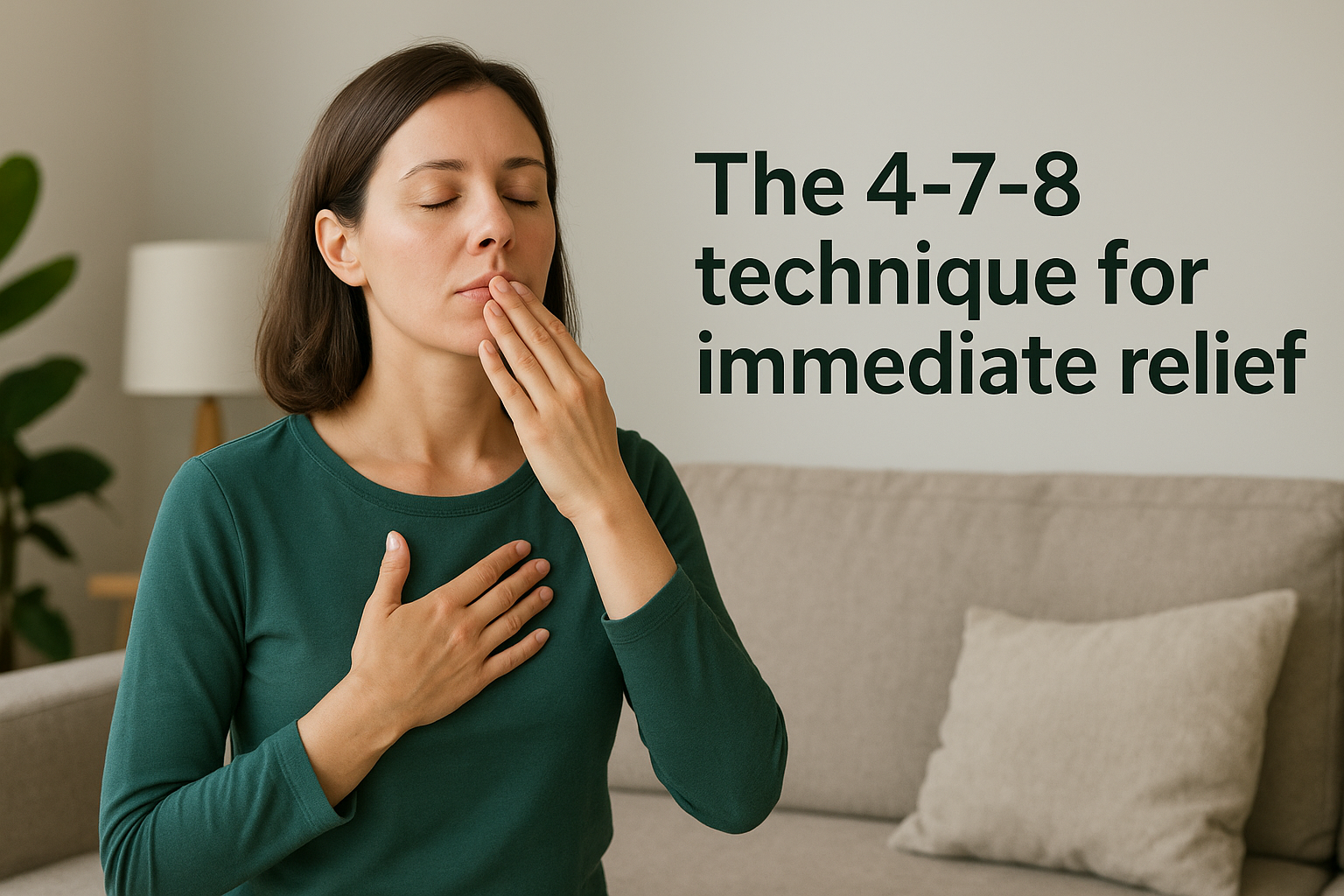
Here's how to practice it:
- Sit or stand comfortably with your spine straight
- Exhale completely through your mouth, making a whoosh sound
- Close your mouth and inhale quietly through your nose for 4 counts
- Hold your breath for 7 counts
- Exhale completely through your mouth for 8 counts, making a whoosh sound
- Repeat the cycle three more times for a total of four breaths
Start with four breath cycles and notice the shift in your body. You might feel lightheaded at first, which is normal as your body adjusts to fuller oxygen exchange. If this happens, return to normal breathing and try again with shorter counts until you build tolerance.
"Feelings come and go like clouds in a windy sky. Conscious breathing is my anchor." – Thích Nhất Hạnh
Box breathing when you need grounding
Box breathing uses equal counts for each phase of breathing, creating a rhythm that's easy to remember and practice anywhere. Military personnel and first responders use this technique because it reduces stress while maintaining alertness, making it ideal for situations where you need to stay sharp while managing pressure.
Practice box breathing this way: Inhale through your nose for 4 counts, hold for 4 counts, exhale through your mouth for 4 counts, hold empty for 4 counts. Repeat for 2-3 minutes. You can adjust the count length based on your lung capacity; some people prefer 5 or 6 counts per phase. The key is maintaining equal duration for each part of the cycle, which helps your nervous system find balance and brings your mind into the present moment.
Step 3. Release tension with a body scan
A body scan is a systematic practice of moving your attention through different parts of your body, noticing sensations without trying to change them. This technique works for mindfulness for stress management because stress often manifests as physical tension you carry unconsciously throughout your day. Your shoulders might be hunched, your jaw clenched, your stomach tight, but you only become aware of these patterns when they cause pain or exhaustion. The body scan trains you to detect and release tension before it accumulates to that point, giving you a practical tool for preventing stress from building in your physical body.
This practice creates change through awareness rather than force. You're not trying to relax tense muscles or push sensations away. Instead, you simply direct your attention to each body part, notice what's there, and let your nervous system respond naturally. Research shows that this approach reduces muscle tension more effectively than trying to force relaxation, because fighting against tension creates more stress. Your body knows how to release what it's holding when you give it permission through gentle awareness.
"The curious paradox is that when I accept myself just as I am, then I can change." – Carl Rogers
Basic body scan practice
Start in a comfortable position, either lying down or sitting with your back supported. Close your eyes or soften your gaze toward the floor. Take three slow breaths to settle in, then bring your attention to your left foot. Notice any sensations: warmth, coolness, tingling, pressure, or numbness. You're not looking for anything specific; you're simply observing what's present.
Follow this sequence through your body:
- Left foot and toes (30 seconds)
- Left lower leg, knee, and thigh (30 seconds)
- Right foot through right thigh (1 minute)
- Pelvis, hips, and lower back (30 seconds)
- Abdomen and chest (30 seconds)
- Shoulders, arms, and hands (1 minute)
- Neck, jaw, and face (30 seconds)
- Top and back of head (30 seconds)
When you notice areas holding tension, breathe into that space and imagine releasing the grip on your exhale. Your mind will wander constantly; this is normal. Each time you notice your thoughts have drifted, gently return your attention to wherever you are in the body scan without judging yourself for losing focus.
When and where to use body scans
Practice body scans at bedtime when racing thoughts keep you awake. The systematic movement of attention gives your mind something concrete to focus on besides worries, while the physical release helps your body settle into sleep mode. Many people fall asleep before completing the full scan, which is perfectly fine; you've achieved the goal of transitioning into rest.
Use shortened versions during your workday when you notice stress accumulating. Take two minutes to scan just your shoulders, neck, jaw, and hands, the areas where most people hold work-related tension. You can do this sitting at your desk with your eyes open, making it invisible to others while giving yourself a reset before your stress compounds into afternoon exhaustion or evening irritability.
Step 4. Move mindfully to break the stress cycle
Movement breaks the feedback loop between your mind and body that keeps stress cycling through your system. When you sit still while stressed, your body stays locked in tension patterns that feed anxious thoughts, which in turn create more physical tightness. Mindful movement interrupts this cycle by giving your body something productive to do with the stress energy while anchoring your attention in physical sensation rather than worried thinking. This doesn't require a gym or special equipment. You can practice mindfulness for stress management through movement in your office, your living room, or even while walking to your car.
The key difference between mindful movement and regular exercise is where you place your attention. You're not trying to burn calories, achieve a fitness goal, or distract yourself from stress. Instead, you focus deliberately on the physical sensations of moving: the pressure in your feet as they contact the ground, the stretch in your muscles, the rhythm of your breath matching your pace. This focused attention is what transforms ordinary movement into a mindfulness practice that calms your nervous system.
Walking meditation for accessible practice
Walking meditation gives you a portable stress management tool that works anywhere you have ten feet of space. You move slowly and deliberately, paying attention to each component of walking that you normally do on autopilot. This practice works particularly well when you're too restless to sit still for breathing exercises or body scans, because it channels your agitation into purposeful movement while keeping you present.
Practice walking meditation this way:
- Stand still and feel both feet firmly on the ground
- Shift your weight to your left foot, noticing how the pressure changes
- Lift your right foot slowly, feeling your heel leave the ground, then your toes
- Move your right foot forward, aware of it traveling through air
- Place your right foot down, heel first, then roll through to your toes
- Shift your weight onto your right foot completely
- Repeat with your left foot, maintaining this slow, deliberate pace
Walk back and forth across a room or follow a path for 5-10 minutes. Your mind will race ahead or pull you into thoughts constantly. Each time this happens, return your attention to the physical sensation of your feet contacting the ground. Speed doesn't matter; awareness does.
"If you are depressed, you are living in the past. If you are anxious, you are living in the future. If you are at peace, you are living in the present." – Lao Tzu
Quick stretches for desk-bound stress
Target the areas where stress accumulates when you can't leave your workspace. These stretches take less than three minutes and release the most common tension points without drawing attention in a professional setting.
Shoulder releases: Roll your shoulders backward five times slowly, feeling each part of the circular motion. Neck stretches: Tilt your head toward your right shoulder, hold for three breaths, then switch sides. Wrist and hand tension: Extend your arms, flex your wrists back, and spread your fingers wide for five breaths. Seated spinal twist: Place your right hand on the back of your chair, left hand on your right knee, and rotate your torso to the right for five breaths, then switch sides.
Perform these stretches while noticing sensations rather than pushing through pain. You're releasing held tension, not proving flexibility.
Step 5. Bring mindfulness into daily tasks
You don't need to carve out separate meditation time to practice mindfulness for stress management. The most sustainable approach involves weaving awareness into activities you already do every day. Washing dishes, drinking coffee, brushing your teeth, and commuting all become opportunities to train your attention and interrupt stress patterns. This approach removes the barrier of "finding time" while building a consistent practice that compounds throughout your day. Each moment you bring deliberate awareness to a routine task strengthens the neural pathways that help you stay grounded under pressure.

The practice works because mundane tasks happen on autopilot, which means your mind defaults to rumination, worry, or mental planning. Redirecting your attention to the sensory experience of what you're doing pulls you out of stressful thought loops and anchors you in the present moment. You're training the same awareness muscle you use during formal meditation, but in a context that integrates seamlessly with your existing schedule.
"The little things? The little moments? They aren't little." – Jon Kabat-Zinn
Transform routine activities into practice
Choose one daily activity you'll commit to doing mindfully for the next week. Pick something you do consistently, like making your morning coffee, showering, or eating breakfast. During that activity, engage all your senses deliberately. If you're making coffee, notice the sound of water running, the smell of grounds, the weight of the mug in your hand, the temperature change as you pour, the taste of the first sip. When your mind wanders to your to-do list or yesterday's argument, gently guide your attention back to the sensory details of what you're doing right now.
Apply the same approach to these common tasks:
Washing dishes: Feel the water temperature, notice how soap creates suds, hear the sound of dishes clinking, observe how your hands move through the motions.
Driving or commuting: Notice your hands on the wheel or rail, the vibration of movement, the changing scenery, your posture in the seat.
Eating: Put your phone away, take smaller bites, chew slowly, notice flavors and textures changing as you eat.
Brushing teeth: Feel the bristles against your gums, taste the toothpaste, notice the circular motion of your hand, hear the brushing sound.
Start with just one activity practiced mindfully each day. Once that becomes habitual, add a second task. You're building a practice that doesn't require extra time but transforms how you experience time you already spend.
Use transitions as mindfulness anchors
Every time you move between activities, pause for three conscious breaths. Before you open your laptop, after you hang up a phone call, when you get in your car, as you walk through a doorway. These transition moments accumulate dozens of brief mindfulness practices throughout your day without requiring you to remember to meditate. Set physical cues that remind you to pause: a note on your computer monitor, a specific bracelet you wear, your phone's lock screen. Each time you notice the cue, take those three breaths and reset your awareness before diving into the next task.
Step 6. Work with stressful thoughts and emotions
Thoughts and emotions are the hardest part of stress to manage because they feel so real and urgent. Your mind tells you that you need to solve everything right now, that the worst-case scenario is inevitable, or that you can't handle what's happening. These thought patterns trigger physical stress responses even when no actual threat exists. The goal of mindfulness for stress management isn't to eliminate difficult thoughts or suppress uncomfortable emotions. Instead, you learn to observe them without getting swept away by their momentum, which creates space to respond deliberately rather than react automatically.
Label thoughts to create distance
Naming what you're thinking reduces its power over you. When you notice a stressful thought, silently label it using simple, neutral categories. Say to yourself "worrying" when you're catastrophizing about the future, "planning" when you're mentally rehearsing scenarios, "remembering" when you're replaying past events, or "judging" when you're criticizing yourself or others. This practice comes from Acceptance and Commitment Therapy, which research shows decreases emotional reactivity by helping you recognize thoughts as mental events rather than facts.
Practice this technique during stressful moments:
- Notice when a thought is creating stress
- Name the type of thinking happening ("worrying," "judging," "catastrophizing")
- Return your attention to your breath or body sensations
- Repeat the process each time a stressful thought pulls you in
The labeling creates separation between you and your thoughts. You're not your anxiety; you're the person noticing anxious thoughts moving through your awareness. That distinction matters when stress feels overwhelming.
"You are the sky. Everything else is just the weather." – Pema Chödrön
Respond to emotions without amplification
Emotions have a natural lifecycle that lasts 90 seconds when you don't interfere with them. The problem is that most people either suppress emotions, which locks them in your body as tension, or amplify them by creating stories about why you feel this way and what it means about your life. Mindfulness asks you to do neither. Instead, locate the emotion in your body, notice its physical qualities (tight, hot, heavy, fluttering), and let it move through without adding narrative.
When stress triggers anger, anxiety, or frustration, use this framework:
Physical location: Where do you feel this emotion in your body?
Sensation quality: What does it feel like (pressure, temperature, movement)?
Intensity: Rate it from 1-10 without judgment.
Changes: Notice if the sensation shifts, grows, or fades as you observe it.
Track one emotion this way for two minutes and you'll often find it changes or dissolves without any action on your part beyond awareness.
Step 7. Make mindfulness stick at work and bedtime
Work and sleep are the two stress hotspots where most people struggle to maintain calm. Your workplace demands constant productivity, quick decisions, and interaction with others, all while stress accumulates throughout the day. Then at bedtime, when your body needs rest, your mind replays every stressful moment and rehearses tomorrow's challenges. These two periods need targeted mindfulness practices that fit their specific constraints. You can't disappear for twenty-minute meditations at your desk, and you can't engage in energizing practices when you're trying to fall asleep. The techniques that work in these contexts are brief, discreet, and designed for their unique requirements.
Micro-practices for workplace stress
Build a habit of one-breath resets throughout your workday by linking them to activities you already do repeatedly. Every time you switch browser tabs, take one full conscious breath. Before you send an email, pause for one breath. After each meeting ends, sit for one breath before standing up. These micro-moments take three seconds but anchor you in the present dozens of times per day, preventing stress from compounding unnoticed until it overwhelms you.
Create a midday reset template you can complete in five minutes:
- Close your eyes for 30 seconds (or look down if privacy is limited)
- Take three 4-7-8 breaths to activate your parasympathetic nervous system
- Scan shoulders, neck, and jaw for tension, releasing what you find
- Set an intention for how you want to approach the afternoon
- Return to work with renewed awareness
Practice this reset every day at the same time, ideally around 2 p.m. when energy typically dips and stress peaks. Consistency matters more than duration when building sustainable mindfulness for stress management into a busy schedule.
"Almost everything will work again if you unplug it for a few minutes, including you." - Anne Lamott
Wind-down routine for better sleep
Start your bedtime mindfulness practice 30 minutes before you want to fall asleep, not when you're already lying in bed frustrated about not sleeping. This preparation time signals to your body that rest is coming and gives your mind space to process the day without the pressure of needing to fall asleep immediately.
Follow this sequence for consistent results:
7:30 p.m.: Dim lights throughout your home (bright light suppresses melatonin)
9:00 p.m.: Stop checking email and social media
9:30 p.m.: Take a warm shower or bath, noticing the water temperature and sensation
9:45 p.m.: Practice a 10-minute body scan lying in bed
10:00 p.m.: If still awake, breathe naturally and count each exhale from 1 to 10, repeating until sleep comes
Your mind will resist this structure initially, insisting you need to check just one more thing or solve one more problem. Treat the routine as non-negotiable for three weeks, the time needed to establish a new habit. Track your sleep quality and stress levels during this period to see measurable improvement in both.
Next steps
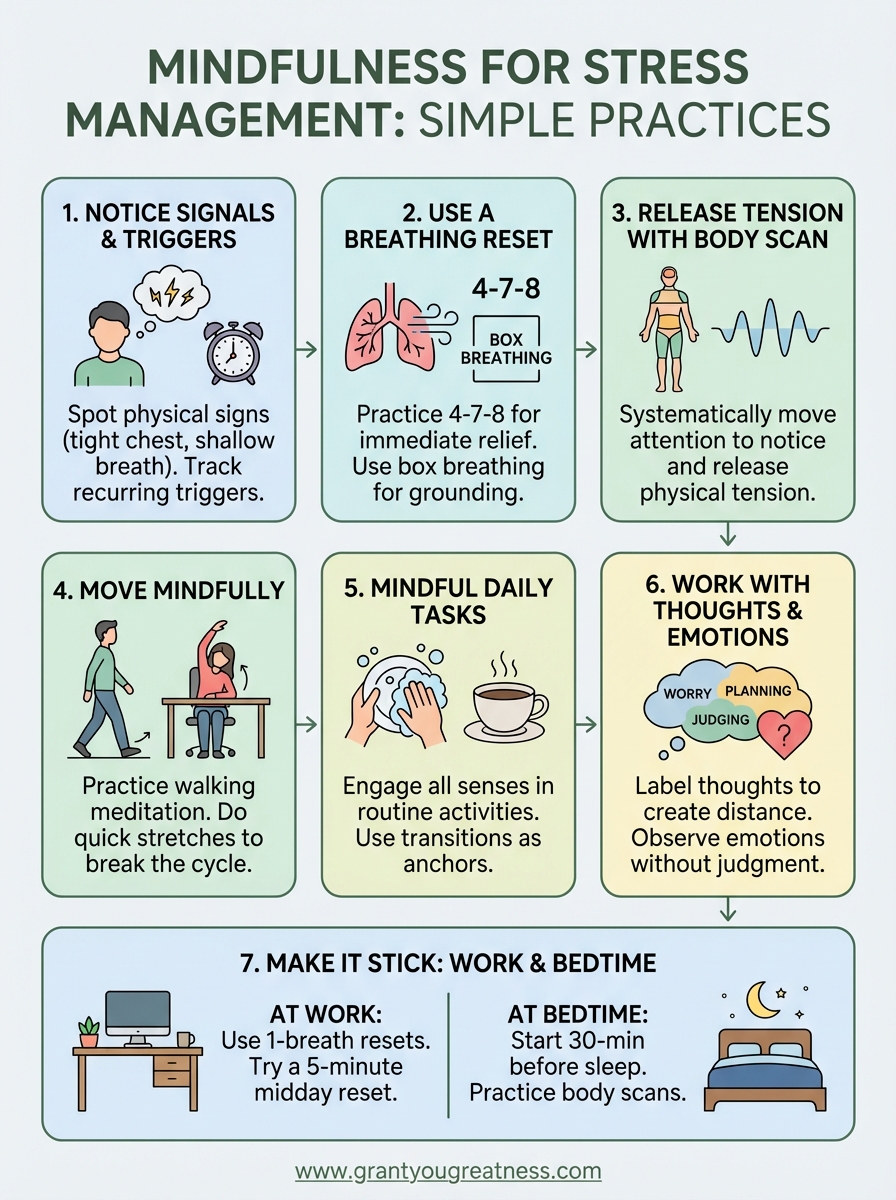
You now have seven practical techniques for mindfulness for stress management that work in real-world situations. Start with one practice that fits your current stress pattern: breathing resets for acute anxiety, body scans for physical tension, or mindful movement when restlessness dominates. Commit to that single technique for two weeks before adding another. Consistency with one practice creates better results than jumping between multiple approaches without building any of them into habit.
Stress management becomes more effective when you work with someone who understands both the techniques and the underlying patterns keeping you stuck. If you're dealing with persistent anxiety, difficult transitions, or feeling burned out despite your best efforts, professional guidance makes the difference between managing symptoms and addressing root causes. Dr. Grant Horner at Grant You Greatness works with clients throughout North County San Diego and online, combining practical mindfulness tools with evidence-based therapy to help you build a life that works.