How To Set Career Goals With SMART Steps And Examples Today
You've been showing up, doing the work, maybe even getting promotions, but something still feels off. That nagging sense that you're drifting rather than driving your career forward is more common than you think. Learning how to set career goals is often the missing piece between feeling stuck and building a professional life that actually excites you.
Clear career goals do more than organize your ambitions, they give your daily efforts direction and meaning. Without them, even talented professionals end up reactive instead of intentional, waiting for opportunities instead of creating them. The good news? Goal-setting is a skill you can learn, not some innate talent reserved for the highly motivated.
This guide walks you through a practical framework for setting career goals that stick, including the SMART methodology and real examples you can adapt to your situation. At Grant You Greatness, career counseling is one of the core services we offer because we've seen firsthand how the right goals transform professional frustration into focused action. Whether you're considering a major career shift or simply want more clarity in your current role, you'll leave with a concrete plan to move forward.
What career goals are and why they matter
Career goals are specific professional outcomes you want to achieve within a defined timeframe. They might include landing a leadership role, building expertise in a new skill, increasing your income by a certain percentage, or transitioning into a different industry entirely. Unlike vague wishes like "I want to be successful," actual career goals give you clear targets you can measure and track. Understanding how to set career goals means learning to translate your broader professional ambitions into concrete milestones that guide your daily decisions.
Why most people struggle without them
You drift through your workweek checking boxes but never feeling real progress. Without defined goals, your career becomes a series of reactions rather than intentional choices. You take whatever opportunities appear instead of creating the ones you actually want. This reactive approach leaves professionals feeling stuck for years, wondering why promotions go to others or why their skills never seem to advance beyond a certain point. The absence of clear goals doesn't just slow your progress, it makes burnout far more likely because you can't see the purpose behind your effort.
Most professionals don't lack ambition, they lack a structured way to channel it toward meaningful outcomes.
The proven benefits of goal clarity
Career goals create a filter for every professional decision you face. When an opportunity appears, you can quickly assess whether it moves you toward your target or distracts from it. Research from goal-setting studies consistently shows that people who write down specific objectives achieve them at significantly higher rates than those who keep goals vague or mental. You gain motivation from tracking progress, even small wins compound into major career shifts over time. Goals also help you communicate your ambitions clearly to managers, mentors, and your network, which opens doors you'd otherwise miss. The benefits extend beyond professional achievement too. Knowing where you're headed reduces anxiety about your career trajectory and gives you confidence to make strategic moves, whether that's asking for a raise or turning down projects that don't align with your direction.
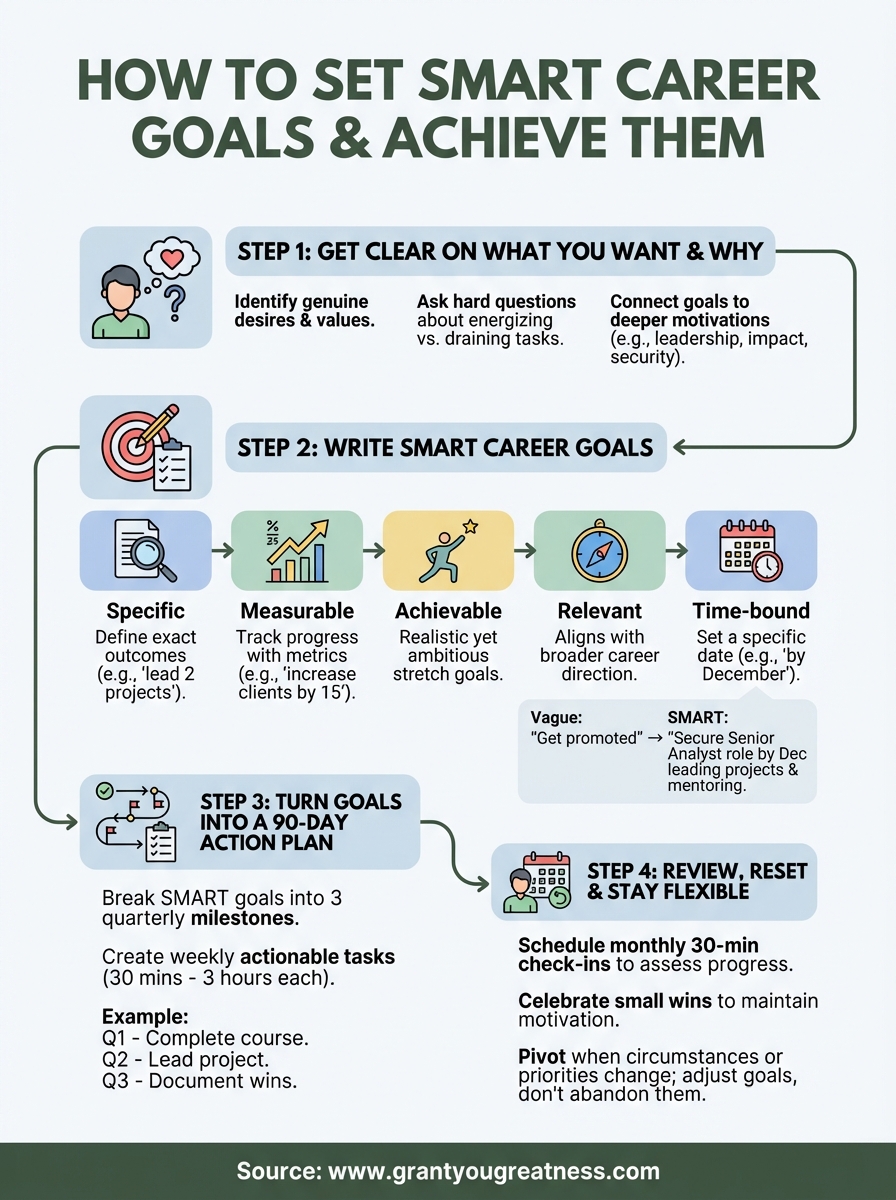
Step 1. Get clear on what you want and why
Before you can master how to set career goals, you need honest clarity about what you actually want from your professional life. This step feels simple but most people skip it entirely, jumping straight to setting goals based on what they think they should want rather than what genuinely matters to them. Spend real time here because vague aspirations produce vague results, and you'll waste months chasing objectives that never satisfy you even when achieved.
Ask yourself the hard questions first
Pull out a notebook and answer these questions without filtering your responses. What parts of your current role energize you versus drain you? If you could design your ideal workday three years from now, what would you be doing and who would you be working with? What professional achievement would make you feel genuinely proud rather than just externally impressive? These questions reveal patterns about what you value, whether that's autonomy, impact, creativity, leadership, or something else entirely. Your answers become the foundation for goals that actually align with who you are.
The clearer you are about what success means to you personally, the less you'll be swayed by other people's definitions of achievement.
Connect goals to your deeper motivations
Every meaningful career goal needs a compelling reason behind it that goes beyond surface level. "I want a promotion" falls flat, but "I want a leadership role because I'm energized by developing others and creating team culture" gives you fuel when obstacles appear. Write down not just what you want but why it matters to your life. Maybe you're pursuing a new skill because it opens creative possibilities, or targeting higher income because it provides security for your family. These deeper motivations keep you committed when progress gets difficult.
Step 2. Write SMART career goals that stick
The SMART framework transforms fuzzy ambitions into concrete targets you can actually track and achieve. When you're figuring out how to set career goals, this methodology gives you a proven structure that prevents the common trap of setting goals so vague they're impossible to measure. SMART stands for Specific, Measurable, Achievable, Relevant, and Time-bound, and each element serves a distinct purpose in making your goals actionable rather than aspirational.
The SMART framework applied to career goals
Specific means you define exactly what success looks like. Instead of "get better at presentations," you'd write "deliver quarterly team presentations without using speaker notes." Measurable adds numbers or clear evidence so you know when you've succeeded. "Increase my client portfolio by 15 accounts" beats "grow my book of business" every time. Achievable keeps you realistic, you want stretch goals but not fantasies that set you up for failure. Relevant ensures the goal actually moves you toward your broader career vision rather than being a distraction. Time-bound creates urgency by adding a deadline, turning someday into a specific date.

The difference between a wish and a goal is the specificity you bring to defining it.
SMART career goal examples
| Vague Goal | SMART Version |
|---|---|
| Learn coding | Complete Python for Data Analysis certification by June 30 and build three working projects |
| Get promoted | Secure promotion to Senior Analyst by December by leading two cross-functional projects and mentoring junior team members |
| Improve networking | Connect with five industry leaders monthly through LinkedIn and attend three professional events per quarter |
Each example includes what you'll do, how you'll measure it, and when you'll complete it. Use this template when writing your own goals to ensure you hit every SMART element.
Step 3. Turn goals into a 90-day action plan
Knowing how to set career goals means nothing if they sit in a document gathering digital dust. You need a practical system that translates your SMART goals into daily action, and the 90-day sprint framework gives you exactly that. This timeframe is long enough to make real progress but short enough to maintain focus and urgency, turning abstract objectives into tangible weekly tasks you can check off your calendar.

Break your goal into quarterly milestones
Take one SMART goal and work backward from your deadline to identify three or four major milestones you need to hit. If your goal is securing a promotion by December, your Q1 milestone might be completing a leadership training course, Q2 could involve leading your first cross-functional project, and Q3 might focus on documenting measurable wins for your review. Each milestone should represent a significant step forward that you can verify when complete. This breakdown prevents overwhelm by showing you exactly what needs to happen each quarter.
Breaking big goals into quarterly chunks makes the impossible feel immediately actionable.
Create weekly action steps
Now drill down to specific tasks you can schedule this week. Your 90-day plan should list concrete actions for the next 12 weeks, with at least one task per week directly advancing your goal. Use this simple template:
Week 1-4: Research three leadership courses, enroll in top choice, complete first two modules
Week 5-8: Finish course, identify cross-functional project opportunity, pitch idea to manager
Week 9-12: Launch project, schedule weekly check-ins, document early wins
Each action should take between 30 minutes and three hours to complete, making it realistic to fit around your current responsibilities.
Step 4. Review, reset, and stay flexible
Your career goals aren't meant to be written in stone and forgotten. The most effective professionals treat goal-setting as an ongoing process, regularly assessing what's working and what needs adjustment. Understanding how to set career goals includes building a review system that keeps you honest about progress while allowing room to pivot when your situation or priorities shift. This step prevents you from either abandoning goals too quickly or stubbornly pursuing objectives that no longer serve you.
Schedule monthly check-ins with yourself
Block 30 minutes at the end of each month to review your 90-day action plan. Ask yourself three questions: What progress did I make this month? What obstacles appeared and how can I address them? Do my current goals still align with where I want to go? Document your answers in the same place you keep your goals so you can track patterns over time. These check-ins reveal whether you're consistently hitting your weekly tasks or if you need to adjust your timeline. Monthly reviews also help you celebrate small wins that might otherwise go unnoticed, which maintains motivation during long-term pursuits.
Regular review turns goal-setting from a one-time event into a dynamic system that adapts with you.
Pivot when circumstances change
Your industry shifts, a new opportunity appears, or your personal priorities evolve. These changes don't mean you failed at goal-setting, they mean you're responding intelligently to new information. If a goal no longer makes sense, revise it rather than forcing yourself down the wrong path. Maybe you discover that leadership isn't actually what energizes you, or a company restructure eliminates the position you were targeting. Adjust your goals to reflect reality while keeping your deeper motivations intact. Flexibility isn't weakness, it's strategic thinking.
Your next move
You now have a complete framework for how to set career goals that create real momentum instead of empty resolutions. The SMART methodology, 90-day action plans, and monthly reviews give you everything you need to transform vague ambitions into achieved objectives. The gap between knowing and doing is where most professionals get stuck, so commit to taking the first step today rather than waiting for perfect clarity.
Pick one career goal right now and write it down using the SMART format. Block 20 minutes on your calendar this week to create your first 90-day action plan, then schedule your monthly review sessions for the next three months. Action beats perfection when it comes to career progress, and momentum builds faster than you expect once you start moving.
If you're struggling to gain clarity on what goals actually matter to you, or you keep setting objectives that don't stick, professional guidance makes the difference. Career counseling at Grant You Greatness helps you cut through the confusion and build a career path that genuinely fits your strengths and values.